7 realistic ways to earn money using AI—and what each one actually takes
Most posts about making money with AI show a prompt and skip straight to the payout. This breakdown walks through seven practical paths, from podcast editing and no-code automation to digital products and small AI tools, using real platform fees, monetization thresholds, and licensing rules so you know what each option actually requires before spending a dollar.

Table of Contents8 sections
Most posts about making money with AI skip the boring part. They show a prompt, flash a revenue screenshot, and jump straight to the payout. The middle (unpaid setup, client revisions, platform fees, and distribution) gets left out.
I checked the current fee schedules and commercial licensing rules across the platforms people use to sell AI-assisted work. The numbers tell a plainer story than social media does. AI cuts production time, sometimes sharply. It does not find buyers or absorb platform cuts for you.
Before picking a path, here is how seven realistic options compare.
| Path | Starter tool cost | Skill that actually pays | Main bottleneck |
|---|---|---|---|
| Audio, podcast editing, and voiceovers | $5–$24/month | Audio cleanup and pacing | Commercial licensing and client outreach |
| Short-form video production | $0–$20/month | Pacing and storytelling | Monetization thresholds or client outreach |
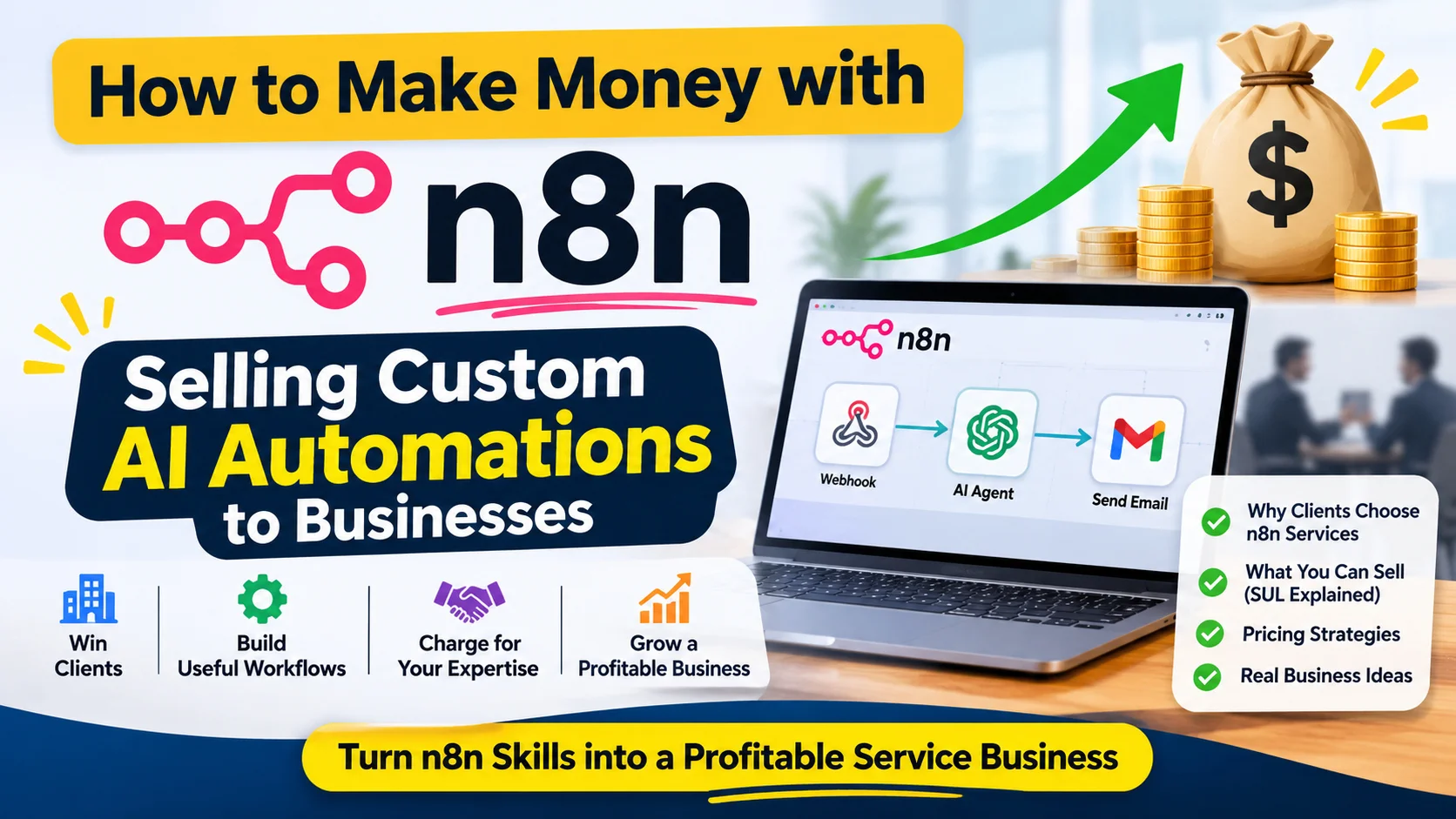
| No-code workflow automation | $0–$20/month | Process mapping and debugging | Pitching small businesses |
| Niche digital products | $0–$20/month | Solving one narrow problem | Getting traffic after launch |
| Visual design for e-commerce | $10–$30/month | Layout taste and cleanup | Licensing rules and image artifacts |
| AI data evaluation tasks | $0 | Rubric accuracy and reading | Unpaid tests and uneven queues |
| Small AI web tools and bots | $20+/month + API | Support and distribution | Converting paying subscribers |
Every path above can bring in real money. None runs on autopilot.
1. Audio, podcast editing, and voiceover production
Podcasters, YouTubers, and online course creators record plenty of raw audio, yet most hate cleaning background hum, cutting awkward pauses, and turning episodes into multilingual dubs or clean voiceovers. AI tools now strip out room echo and generate studio-grade speech in minutes instead of hours.
Clients do not pay for robotic synthetic narration dropped untouched onto a track. They pay for natural pacing, consistent loudness across speakers, and clean delivery ready to publish.
Paid plans are mandatory once you charge clients. ElevenLabs requires a paid subscription for a commercial license: its Starter plan costs $5/month billed annually ($6/month billed monthly) for 30,000 credits/month, while Creator runs $22/month billed monthly ($18.33/month annually) for 121,000 credits/month. For transcript-based podcast cleanup, Descript's free tier ($0/month) stops at 1 media hour/month with watermarked 720p exports; Hobbyist costs $24/month billed monthly ($16/month annually) for 10 media hours/month, and Creator runs $35/month monthly ($24/month annually) for 30 media hours/month. Never clone a client's or actor's voice without clear written permission.
Winning clients on freelance marketplaces also comes with real deductions. Upwork charges a variable freelancer service fee ranging from 0% to 15% per contract (shown before you send a proposal and locked for that contract). On a $500 contract at the top 15% rate, Upwork takes $75 and leaves $425 before withdrawal charges like the $0.99 Direct to Local Bank fee. Fiverr takes a flat 20% service fee on every completed order, so a $500 project leaves $400, and regular sellers wait through a 14-day clearance period before cashing out.
This fits detail-oriented listeners who notice bad audio right away. Skip it if you do not have patience for fine-tuning timing and pitching creators directly.
2. Short-form video and creator production
Vertical videos and YouTube channels consume a steady stream of scripts, captions, and tight edits. You can earn here in two ways: working behind the scenes for existing creators, or building a monetized channel of your own.
Client work pays far sooner. Busy creators and small brands often have raw footage and topic ideas without the time to tighten scripts or add readable subtitles. AI handles transcription and rough outlines while you control pacing and visual polish.
Building your own channel is a much slower climb. Full ad-revenue sharing in the YouTube Partner Program requires 1,000 subscribers plus either 4,000 qualified public watch hours on long-form videos in the past 365 days (Shorts Feed views do not count toward watch hours) or 10 million qualified public Shorts views in the past 90 days. Even the early fan-funding tier requires 500 subscribers, three valid uploads in 90 days, and either 3,000 watch hours or 3 million Shorts views.
Platform rules also matter. YouTube requires creators to disclose realistically altered or synthetic content using its Studio toggle. Routine production assistance like script brainstorming or automatic captions does not need disclosure, and using AI does not automatically block monetization. Repeatedly hiding realistic synthetic footage can lead to content removal or suspension from the partner program, while mass-produced repetitive videos risk falling under YouTube's inauthentic content policies.
Edit for other creators if you need income within weeks. Start your own channel only if you can publish consistently for zero dollars while chasing those thresholds.
3. No-code workflow automation for small businesses
Small businesses waste hours every week copying web-form leads into spreadsheets or drafting repetitive replies to routine customer emails. Visual automation tools let you connect those everyday apps to an AI model without writing a full software product from scratch.
Entry costs stay manageable. Make offers a free tier with 1,000 credits/month and two active scenarios running on 15-minute intervals; its paid Core plan starts around $9–$12/month (billed annually) for 10,000 credits. Zapier provides a free tier of 100 tasks/month restricted to two-step Zaps, while its Professional plan starts at $19.99/month (billed annually) for 750 tasks/month and unlocks multi-step Zaps and webhooks. Once a workflow moves into production, the client normally pays for their own subscriptions and separate AI API usage.
The real job is handling messy reality. Demo automations work smoothly because sample inputs are spotless. Live business data has missing email fields and badly formatted PDFs, and AI responses sometimes break the expected layout. Clients pay you to catch those edge cases so nothing breaks quietly on a Monday morning.
You also have to sell outcomes rather than tools. A local clinic or logistics team does not care about prompts. They care that incoming inquiries land cleanly in their tracker in minutes instead of getting lost in an inbox.
4. Niche digital products and practical guides
Generic prompt packs saturated the market fast because buyers realized they could ask a chatbot for similar lists themselves. Specific, problem-focused digital products still sell: a Notion tracker built for one profession, or a focused practical workbook where AI sped up your research and formatting.
Hosting costs zero upfront on platforms like Gumroad or Amazon Kindle Direct Publishing (KDP), though transaction cuts shape your math.
On Gumroad, direct sales through your own links cost 10% + $0.50 per transaction, plus credit card or PayPal processing fees on top. On a $29 template sold directly, Gumroad's base fee is $3.40, leaving $25.60 before card processing. Netting $1,000 a month before processing takes 40 direct sales every month. If buyers find your item through Gumroad Discover, Gumroad takes a flat 30% fee ($8.70 on a $29 item, leaving $20.30), pushing that $1,000 target to 50 monthly sales.
On Amazon KDP, eBook royalties pay either 70% (typically on books priced $2.99–$9.99 in the US store, minus delivery costs in eligible territories) or 35%. Amazon requires authors to disclose AI-generated text, images, or translations during publishing (even if heavily edited afterward). Using AI solely to brainstorm or polish human-written prose counts as AI-assisted and does not require disclosure.
Making the file is never the bottleneck. Distribution is. Without an audience or steady search traffic, a solid product earns nothing.
5. Visual design and e-commerce assets
Online stores and local brands constantly need clean product mockups and social media ad variations. Combining AI image generators with design tools like Canva or Photoshop lets one person deliver usable concepts much faster than manual illustration or studio shoots.
Raw generated images rarely survive client review untouched. Product labels and embedded text still come out mangled often enough that careful manual editing is mandatory. Clients pay for clean typography and consistent brand styling.
Commercial licensing is strict, and free tiers do not cover client work. Midjourney grants commercial rights only to paid subscribers (Basic costs $10/month, Standard $30/month, Pro $60/month, and Mega $120/month), and any business over $1,000,000 USD in gross annual revenue must subscribe to Pro or Mega. Canva Pro costs $18/month billed monthly and allows commercial use of Magic Media outputs, though Canva notes that users generally cannot claim exclusive copyright over purely AI-generated assets and remain responsible for avoiding third-party trademark or copyright violations.
Keep tool subscriptions lean early on. ChatGPT Plus ($20/month) plus Midjourney Basic ($10/month) and Canva Pro ($18/month) total $48/month before your first client pays.
6. AI data evaluation and training tasks
AI companies hire independent contractors to rate model answers and write rubric-guided prompts across writing, coding, or regional languages. Platforms like DataAnnotation and Outlier AI let you apply without building a client portfolio.
The trade-offs are blunt. First, you have to pass unpaid starter assessments or skill screenings that test reading precision and strict rubric compliance; many applicants never receive a reply afterward. Second, income is unpredictable. Project queues open, change instructions overnight, and vanish without warning.
Location also sets hard boundaries. DataAnnotation focuses its core English work in the US, Canada, UK, Ireland, Australia, and New Zealand. Outlier AI operates across 110+ countries (including Bangladesh) and requires government-issued photo ID matching your primary residence. Both strictly ban VPNs; trying to mask your location gets accounts closed.
Use evaluation platforms for flexible extra cash when projects are live. Never build rent money around them.
7. Small AI web tools and custom client bots
AI coding assistants let solo builders ship small web utilities, such as internal document Q&A bots or invoice extractors, far faster than before.
Shipping version one is no longer the hard part. Keeping a paid tool alive requires customer support and bug fixes, plus watching hosting and AI API bills so one heavy user does not erase your profit, while convincing strangers to subscribe.
Payment gateways also trip up builders outside major Western markets. Most tutorials assume Stripe, yet Bangladesh is not supported for direct Stripe merchant registration, pushing local founders toward forming a foreign entity or using a Merchant of Record. Older blog posts still point to Lemon Squeezy, which permanently closed new store sign-ups. Paddle remains an active Merchant of Record supporting sellers in Bangladesh at 5% + $0.50 per transaction with no monthly fee, while handling global sales tax and VAT. On a $19/month subscription, Paddle keeps $1.45 and leaves $17.55 before hosting and AI API bills. Clearing $1,000/month after Paddle fees requires 57 paying subscribers, and earning 57 recurring buyers takes far more effort than wiring up an API.
Stacking paid tools across several ideas can put you $30–$50/month behind before earning a single dollar. Pick the one path closest to a skill you already practice.
If you edit audio or cut video, start by selling services directly to clients where you can get paid before building an audience. If you know business operations or basic web tooling, validate one small workflow with a real buyer before building anything bigger. AI removes the excuse of slow production; finding someone willing to pay is still the job.
References
- Audio and voiceover tools: ElevenLabs Pricing, Descript Pricing
- Freelance marketplaces and AI assistants: Upwork Help Center, Fiverr Help Center, OpenAI ChatGPT Pricing
- Video monetization and disclosure: YouTube Help Center, YouTube Official Blog
- No-code automation: Make Pricing, Zapier Pricing
- Digital products and publishing: Gumroad Help Center, Amazon KDP
- Visual design licensing: Midjourney Documentation, Canva
- AI data evaluation and payments: DataAnnotation, Outlier AI, Stripe Global Availability, Paddle