What Is Agentic AI? Meaning, Real-World Examples, and How It Works
Regular chatbots stop after giving advice; agentic AI plans steps, calls external tools, checks live feedback, and finishes multi-step work. Here is how it works, explained with everyday analogies, real-world examples, and honest limits.
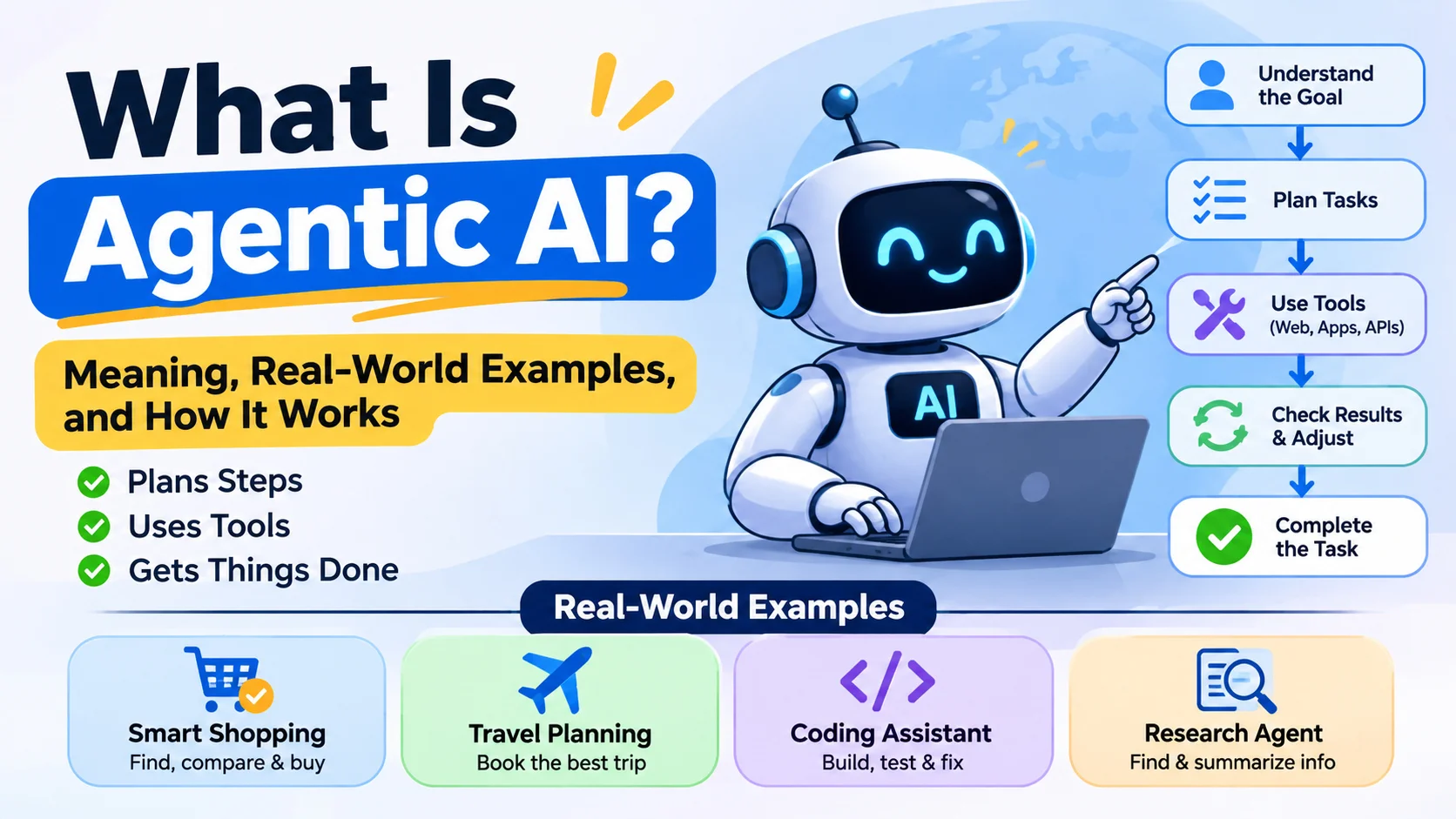
Table of Contents7 sections
Ask a regular chatbot to plan a three-day coastal trip, and it gives you a neat itinerary in seconds. It might suggest a morning train and a beachfront guesthouse. Then it stops. You still check seat availability, notice your sister's birthday dinner clashes with Friday departure, and open four tabs to book everything yourself.
Now hand that same goal to a different kind of software. This system checks your calendar and catches the Friday conflict. It looks up live Saturday trains instead, compares rooms inside your budget, spots a Sunday storm warning, and messages you before spending money to confirm a refundable booking.
That gap between offering advice and finishing a job is the core idea behind agentic AI.
Tech companies now attach the word agentic to almost every launch, often stretching it over plain chat boxes or rigid scripts. Strip away the marketing fog and the concept is straightforward, because we already use it every day.
What agentic AI actually means
The word agentic comes from agency: the capacity to act independently toward a goal. IBM defines agentic AI around autonomy and purposeful action, noting that these systems pursue objectives and adapt as conditions change. Google Cloud draws a similar boundary: traditional AI mostly answers commands or analyzes data, whereas agentic AI plans and executes multi-step work with minimal human intervention.
A regular generative model waits for your prompt, replies from training data, and falls silent until you type again. An agentic system places that language model inside a working loop. You give it an objective instead of a one-off question. From there, it chooses the next move, pulls live facts through external tools, fixes failed steps, and keeps going until the job finishes or needs your approval.
Think of the difference between a cookbook and a private chef.
Suppose you want dinner for four guests by eight in the evening, with one guest allergic to peanuts. A cookbook behaves like standard generative AI. Ask what to make with chicken and pantry spices, and you get written steps. Nothing in the kitchen moves on its own. You still chop onions, discover fresh ginger ran out, taste the curry, and watch the stove so the rice does not burn.
A chef works differently. You state the goal: dinner for four, ready by eight, strictly no peanuts. The chef checks the cabinets, adapts when ginger is missing, tastes the dish midway to adjust salt, and puts dinner on the table on time. Agentic AI brings that chef-like pattern into software: it observes its surroundings while using tools to reach your goal.
How it differs from chatbots and fixed automation
People often mix up agentic AI with rule-based automation and conversational chatbots. Each saves real time, yet they react very differently once anything goes off script.
Picture three everyday helpers: a vending machine, a reference librarian, and a junior project assistant.
Fixed automation behaves like a vending machine. Every path is hardcoded in advance. Drop in coins and press B4; chips fall into the tray. When nothing unexpected happens, it is fast and cheap. If a packet snags on the glass, though, it cannot improvise because it has no awareness that your goal is getting a snack. Classic spreadsheet macros and rigid scripts work the same way: rename one column or move a webpage button, and the script breaks.
A standard chatbot behaves like a sharp librarian behind a reference desk. Ask an open-ended question, and the librarian explains tax rules or summarizes a contract. Unlike the vending machine, the librarian handles messy human language easily. Still, the librarian stays behind the desk and waits for your next question instead of walking across town to submit your paperwork and return with a receipt.
An agentic system acts more like a junior project assistant. You share an objective plus approved tools like a calendar and spreadsheet. The assistant chooses what comes first, gathers missing facts, adjusts when a vendor replies late, and checks in before spending money or emailing a client.
In its December 2024 guide on building effective agents, Anthropic cleared up much of the industry confusion by separating workflows from agents. Workflows are systems where language models and tools follow predefined code paths written by developers. Agents are systems where the language model dynamically directs its own processes and tool usage, keeping control over how it finishes the job.
| System type | Who controls the steps | Reaction to surprises | Everyday analogy |
|---|---|---|---|
| Fixed automation | Hardcoded rules | Stops with an error | Vending machine |
| Standard chatbot | Human prompts each turn | Suggests options in text | Reference librarian |
| AI workflow | Predefined code calling AI | Follows coded branches | Assembly line with smart checks |
| Agentic AI | The AI model decides dynamically | Reads feedback and replans | Junior project assistant |
That line matters. Many reliable products place an AI model inside fixed code paths without giving it the steering wheel. True agency starts only when the model chooses its next move from live feedback.
How agentic AI works under the hood
Watching an AI agent inspect files and fix its own bugs can look mysterious from outside. Under the hood, most agents combine four clear parts inside a repeating loop.
In her June 2023 overview of LLM-powered autonomous agents, researcher Lilian Weng mapped an agent around a central large language model supported by planning, memory, and tool use. Wire those parts into a feedback loop, and you have the blueprint behind nearly every modern agent.
At the center sits the large language model (LLM) as the reasoning core. Trained on huge amounts of text and code, it interprets open-ended goals and outputs structured commands. Alone, an LLM sits in a locked room. It cannot check live fares or inspect a private database unless software connects it outward.
Planning turns a broad objective into smaller subgoals. Ask an agent to audit last quarter's refund tickets for policy exceptions, and it maps out steps: fetch refund records, read current rules, check each claim, and summarize unusual payouts.
Tool use gives the brain hands and eyes. Engineers expose specific functions the model may call, such as web search or a calendar API. When the model needs current facts or must act rather than guess from memory, it emits a structured tool call and waits for the real result.
Memory keeps the agent coherent across steps and across weeks. Lilian Weng splits memory into two layers: short-term memory matches the active context window (your goal plus recent tool outputs), while long-term memory lives in an external database so preferences and notes can be recalled later.
All four parts come alive inside a feedback loop. A foundational idea here is ReAct, introduced by Shunyu Yao and co-authors in October 2022 and published at ICLR 2023. Rather than scripting an entire plan blindly up front, ReAct alternates between short reasoning traces and concrete actions: think about the next move, call a tool, read the returned observation, and update the plan when reality pushes back.
A related method from Noah Shinn and colleagues in their 2023 Reflexion paper adds verbal self-reflection. When a trial fails, the agent writes a plain-language critique of what went wrong, saves it in episodic memory, and uses it to avoid repeating the error next time.
Picture planning a weekend train trip when schedules fall apart. Your destination sits in your head; open tabs and desk notes form short-term memory; a notebook of family dietary rules acts as long-term memory; your railway app and weather forecast are your tools.
Watch the ReAct loop play out. You check seats on the Friday express (action), see it sold out (observation), and weigh Saturday morning against an intercity bus (thought). Checking bus schedules (action) turns up a highway storm warning (observation), so you book Saturday's train instead. No rigid script guided you. Reasoning combined with live tools and feedback until the plan held. That exact loop turns a passive model into an agent.
Real-world examples of agentic AI
Agentic AI has moved past university labs into daily software, though maturity varies sharply by field.
Software engineering is the clearest proving ground because code returns fast, objective feedback. Edit a file and run tests, and the compiler immediately shows whether the fix worked. Anthropic's Claude Code works across the terminal, IDEs, and desktop or browser apps; it reads an entire codebase, edits files, and runs terminal commands. In May 2025, GitHub launched the GitHub Copilot coding agent: assign an issue to Copilot, and it spins up a background environment via GitHub Actions, runs repository tests, and submits a pull request for review.
Neither behaves like autocomplete. Given a bug report, the agent finds the faulty module, modifies files, runs tests, reads failing logs, and refines its patch before notifying a developer.
Multi-step web research is a second area visible to everyday users. In February 2025, OpenAI released deep research inside ChatGPT for complex internet research. Instead of running one search and summarizing top snippets, it browses hundreds of online sources over tens of minutes, pivots around dead ends, and compiles a cited briefing aimed at research-analyst depth. Anyone who has spent an afternoon comparing regulatory filings immediately feels how different that is from a quick chat reply.
Customer support and back-office work form a third active area. Older support bots felt like rigid FAQ menus; ask one to cancel half a split order while updating a billing address, and it quickly dropped you into a phone queue. Enterprise agent setups described across IBM and Google Cloud connect reasoning models to order databases and return rules. When a multi-part request arrives, the agent checks eligibility, verifies shipping status, issues approved refunds under policy caps, and hands tricky exceptions to a human representative with a concise summary ready.
Supply chain operations follow the same logic. NVIDIA's glossary on autonomous AI agents points to specialized agents handling tasks like supply chain optimization and chip verification inside multi-agent systems. When a port delay hits, an agent linked to inventory and carrier feeds spots threatened orders, compares alternate routes, and gives managers an updated schedule faster than manual spreadsheets.
Every example above shares one trait. None work because the model predicts the future; they work because the model plugs into live environments—code repositories, websites, order databases, inventory feeds—that return concrete feedback after every action.
Single agents versus multi-agent teams
Hearing the phrase AI agent usually brings to mind one assistant working solo. For focused jobs, a single well-scoped agent with a small toolkit is often best: it costs less to run and stays easier to debug.
Once a project spans several domains, stuffing dozens of tools and long rulebooks into one agent backfires. The model starts picking the wrong tool or losing focus inside a crowded context window.
Multi-agent setups solve that crowding by splitting work across specialists carrying narrow instructions and only the tools they need. Anthropic calls one layout the orchestrator-workers pattern: a central model splits a task into subtasks, delegates them to worker models, and merges their outputs. OpenAI's 2025 practical guide similarly covers manager-led coordination alongside decentralized handoffs, where one specialist passes work straight to the next.
An everyday kitchen makes this split obvious. One vendor running a tiny tea stall takes orders and brews tea alone because the menu barely changes. Scale up to a busy restaurant serving forty dishes on Friday night, and a solo operator drowns in ten minutes. So the restaurant divides roles: a head chef coordinates tickets, prep cooks handle ingredients, line cooks run dedicated stations, and servers attend guests.
Multi-agent software follows that division of labor. Inside a research pipeline, one agent pulls approved records, another drafts a briefing, and a reviewer checks every claim against original sources before an editor sees it. Narrow roles keep prompts crisp and isolate errors quickly.
Where agentic AI falls short and why guardrails matter
Amid all the excitement around autonomous software, it is easy to miss how fragile agents remain in practice. Real deployments face three stubborn hurdles: compounding mistakes, higher cost and latency, plus serious security exposure.
Start with simple math. Suppose an agent runs a 10-step task where each independent step succeeds 90% of the time. Across 10 consecutive steps without recovery, the odds of finishing cleanly drop to 0.90 raised to the 10th power, or about 34.9%. Even at 95% accuracy per step, a 10-step chain completes cleanly only around 59.9% of the time. Automated tests and reflection loops catch many slips mid-run, which explains why coding agents outperform agents lacking objective verification. Whenever an agent cannot verify its own output, small mistakes snowball fast.
Cost and speed bring a second tradeoff. A normal chat prompt makes one call and replies in seconds. An agent might fire twenty calls in a loop while reading long files and retrying failed queries. Left unchecked, it chases dead ends and burns budget. Anthropic explicitly notes that agentic systems trade latency and cost for better task performance, advising builders to pick the simplest solution first.
Security is the sharpest risk. When a chatbot blunders, you get a clumsy paragraph or wrong date. Once an agent holds live credentials for email or payment APIs, a blunder becomes a real-world action. The OWASP Top 10 for Large Language Model Applications (2025) places Prompt Injection at the top (LLM01) and flags Excessive Agency (LLM06) beside it. Indirect prompt injection is especially sneaky: an attacker hides instructions inside a webpage or email so the agent mistakes untrusted text for an authorized command and misuses its tools.
Think about hiring a bright new intern on their first Monday. You might ask them to sort travel receipts or compare vendors, yet you would never hand over the master bank password and leave for a week. You start with read-only access, cap spending on a corporate card, require manager sign-off before money moves, and audit every action.
Responsible agent engineering relies on those exact guardrails. Both OpenAI's guide and Anthropic's engineering notes stress layered safeguards: grant minimum permissions, separate untrusted data from system instructions, cap loop counts, and place human-in-the-loop approval before irreversible moves like deleting records or sending funds.
Knowing how agentic AI works—and where it stumbles—gives you a practical filter against hype. When a job follows fixed rules every time, plain code or a simple workflow beats an agent on speed and reliability. When you only need an explanation or first draft, a regular chatbot is plenty. Agentic AI belongs in the messy middle: open-ended, multi-step work where you cannot script every branch up front, live tools return real feedback, and human checkpoints keep the system safely on track.
References
- Anthropic (Dec 19, 2024). Building effective agents. https://www.anthropic.com/research/building-effective-agents (accessed 2026-11-28).
- OpenAI (2025). A Practical Guide to Building Agents. https://cdn.openai.com/business-guides-and-resources/a-practical-guide-to-building-agents.pdf (accessed 2026-11-28).
- Lilian Weng (June 23, 2023). LLM Powered Autonomous Agents. https://lilianweng.github.io/posts/2023-06-23-agent/ (accessed 2026-11-28).
- Shunyu Yao et al. (Oct 2022; ICLR 2023). ReAct: Synergizing Reasoning and Acting in Language Models. https://arxiv.org/abs/2210.03629 (accessed 2026-11-28).
- Noah Shinn et al. (Mar 2023; NeurIPS 2023). Reflexion: Language Agents with Verbal Reinforcement Learning. https://arxiv.org/abs/2303.11366 (accessed 2026-11-28).
- IBM Think. What is Agentic AI? https://www.ibm.com/think/topics/agentic-ai (accessed 2026-11-28).
- Google Cloud. What is agentic AI? https://cloud.google.com/discover/what-is-agentic-ai (accessed 2026-11-28).
- NVIDIA Glossary. What are Autonomous AI Agents? https://www.nvidia.com/en-us/glossary/ai-agents/ (accessed 2026-11-28).
- Anthropic. Claude Code Docs Overview. https://code.claude.com/docs/en/overview (accessed 2026-11-28).
- Thomas Dohmke, GitHub Blog (May 19, 2025). GitHub Copilot: Meet the new coding agent. https://github.blog/news-insights/product-news/github-copilot-meet-the-new-coding-agent/ (accessed 2026-11-28).
- OpenAI (Feb 2, 2025). Introducing deep research. https://openai.com/index/introducing-deep-research/ (accessed 2026-11-28).
- OWASP Foundation (2025). OWASP Top 10 for Large Language Model Applications. https://owasp.org/projects/top-10-for-large-language-model-applications (accessed 2026-11-28).